Call centers have changed significantly in recent years. Agents now work across traditional contact centers, hybrid offices, remote locations, and distributed support teams. At the same time, customers expect conversations to be clear, quick, and professional.
This makes choosing the best noise cancelling headset an important decision for customer service teams, BPOs, sales teams, IT helpdesks, and other voice-based operations.
In 2026, headset selection is also being influenced by new developments in AI-assisted audio processing, microphone-based background-noise suppression, flexible USB connectivity, hybrid work, and greater emphasis on employee comfort and productivity.
Call centers are often busy environments where multiple conversations, keyboards, office equipment, air-conditioning systems, and other background sounds occur simultaneously.
Without effective noise reduction, agents may struggle to concentrate on conversations. Customers may also hear surrounding conversations, reducing the perceived professionalism of the interaction.
A good headset addresses both sides of the conversation. The speakers or ear cushions help the agent hear the customer, while the microphone’s noise-reduction capabilities help ensure the customer’s voice is not competing with unnecessary background sound.
There is no single headset that is perfect for every call center. The right choice depends on the working environment, communication platform, number of daily calls, connectivity requirements, and budget.
However, several features should be considered when evaluating professional headsets.
For a call center, microphone performance is particularly important.
The headset should capture the agent’s voice clearly while minimizing surrounding sounds. Technologies such as directional microphones, environmental noise cancellation, background-noise suppression, and filtering can help improve outgoing voice clarity.
This is different from simply blocking noise for the person wearing the headset. A headset can make the agent’s environment quieter without necessarily preventing the customer from hearing nearby conversations.
Therefore, when comparing noise reduction headphones with mic, pay close attention to microphone performance.
Call center agents may spend many hours wearing their headsets. Even excellent audio technology becomes less useful if the headset causes discomfort.
Look for lightweight construction, adjustable headbands, cushioned ear pads, suitable clamping pressure, and a microphone boom that can be positioned comfortably.
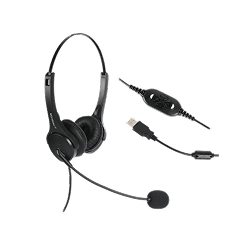
Explore Dasscom Call Center Headsets
Connectivity should match the equipment already used by the organization.
Call centers may operate with IP phones, desktop computers, laptops, softphones, dialers, or multiple platforms. USB, RJ-09, 3.5mm, 2.5mm, and QD connectivity can therefore be useful depending on the deployment.
Dasscom offers headset configurations designed for IP phones, PCs, softphones, laptops, and other communication equipment.
A contact-center headset can experience significantly more daily usage than a typical consumer headset.
Frequent wearing, removing, adjusting, cable movement, and microphone positioning can put stress on the equipment. Businesses should therefore consider construction quality, replacement availability, warranty, and after-sales support alongside the initial purchase price.
The headset market is moving beyond basic audio reproduction. Several trends are particularly relevant in 2026.
AI and advanced digital signal processing are increasingly being used to improve voice communication. Newer audio products are incorporating sophisticated processing to separate voices from ambient sounds and improve call clarity.
For call centers, this trend means microphone intelligence and voice isolation are becoming increasingly important selection criteria.
The practical goal is simple: help the customer hear the agent clearly, even when the surrounding environment is not completely quiet.
Contact-center operations are no longer limited to large centralized offices. Hybrid and remote teams require headsets that work consistently across laptops, desktops, IP phones, and softphone applications.
This makes flexible connectivity and plug-and-play deployment more valuable in 2026.
Businesses are increasingly recognizing that employee comfort affects the overall communication experience.
A headset worn for several hours should not create unnecessary pressure or fatigue. Ergonomics, weight, ear-cushion design, microphone positioning, and ease of adjustment are consequently becoming important purchasing considerations.
USB headsets remain highly relevant for PC-based communication, while multi-interface headsets provide greater flexibility for organizations using different communication systems.
For businesses with changing technology environments, choosing a headset with appropriate connectivity can extend the useful life of the equipment.
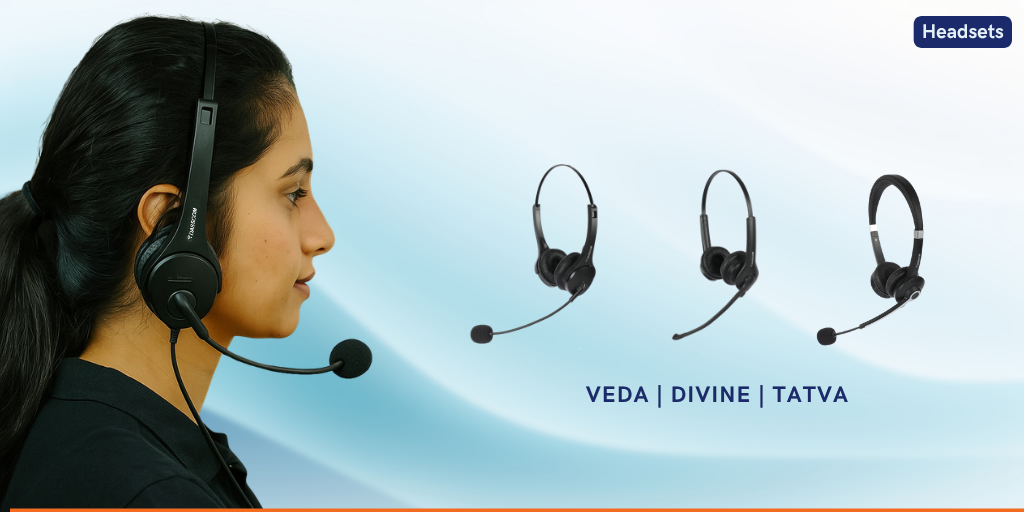
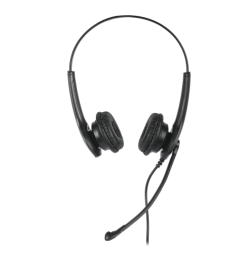
Dasscom offers a dedicated range of professional Call Center Headsets designed for customer support centers, BPOs, helpdesks, sales teams, and remote support operations. Its current range includes the DS-52, DS-900, and DS-1100.
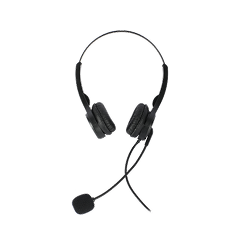
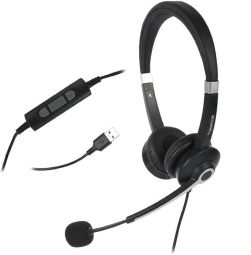
The DS-52 is part of Dasscom’s Veda Series. It is a lightweight binaural headset available with different connectivity options, including USB, 3.5mm, and RJ-09 configurations.
This makes it suitable for organizations that need flexibility across desktop computers, laptops, desk phones, and IP phones.
For smaller and medium-sized contact centers looking for practical connectivity and comfortable daily use, the DS-52 can be a suitable option.
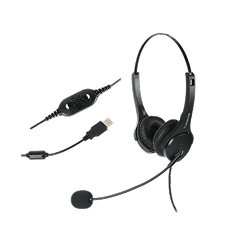
The DS-900 belongs to the Divine Series and is designed for professional agents who require flexibility across different communication environments.
Dasscom lists the model with connectivity options for desk phones, dialpads, IP phones, soft dialers, laptops, PCs, and USB-based setups, depending on the configuration.
This makes it particularly relevant for organizations where agents may work across multiple communication platforms.
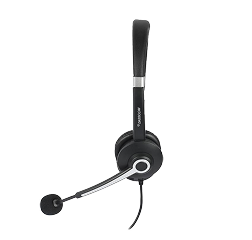
The DS-1100 is part of Dasscom’s Tatva Series. It is designed for high-volume call-center environments and offers multiple interface options, including USB, 3.5mm, 2.5mm, RJ, and QD configurations.
Its broad compatibility with PCs, IP phones, softphones, and dialpads makes it useful for organizations with varied communication infrastructure.
Talk to Dasscom About Headsets
The choice between wired and wireless headsets depends on how agents work.
Wired headsets are generally straightforward to deploy and well suited to fixed workstations. They can be a practical option for large teams where reliability, simplicity, and cost control are priorities.
Wireless headsets provide greater freedom of movement. They can be useful for supervisors, mobile agents, hybrid workers, and environments where employees need to move away from their desks.
However, wireless deployments introduce additional considerations such as battery life, charging, wireless connectivity, and device management.
For a conventional fixed-desk contact center, a professional wired headset can still be an extremely practical choice in 2026.
Single-ear headsets leave one ear open to the surrounding environment. They can be useful for supervisors or employees who need to communicate with colleagues while handling calls.
Binaural headsets cover both ears and can provide greater concentration in busy environments. They are often preferred where agents need to remain focused on customer conversations despite surrounding activity.
Dasscom offers binaural models including the DS-52, DS-900, and DS-1100.
The right choice depends on the environment and the agent’s workflow.
Before purchasing, evaluate the actual working conditions.
First, determine what devices agents use. If the team primarily works on PCs and softphones, USB connectivity may be appropriate. If agents use IP phones, RJ connectivity may be more relevant.
Next, assess the noise environment. A busy BPO floor requires stronger microphone noise suppression than a relatively quiet home office.
Then consider wearing time. Agents working extended shifts should receive lightweight and comfortable equipment.
Finally, consider long-term value. A slightly higher initial investment in durable equipment can be preferable to frequent headset replacement.
Before selecting the best noise cancelling headset, check:
The objective is not simply to find the headset with the longest feature list. It is to identify the headset that matches your agents, technology environment, and operating conditions.
A headset affects every customer conversation an agent handles.
Poor audio can result in customers repeating themselves, agents asking for clarification, and conversations taking longer than necessary. Good audio, meanwhile, helps agents concentrate and communicate more naturally.
For large contact centers, even small improvements in communication quality can matter across thousands of daily interactions.
This is why businesses should evaluate Call Center Headsets as part of their overall communication infrastructure rather than treating them as inexpensive peripherals.
The best noise cancelling headset is the one that combines clear voice transmission, effective noise reduction, comfort, durability, and connectivity for your specific call-center environment. In 2026, AI-assisted audio, hybrid work, and flexible device compatibility are making professional headsets even more important. Dasscom provides multiple options for diverse business communication requirements.



 Indoor Speakers
 Paging Controller
 Outdoor Speakers
 IP Amplifier & Gateway
 Paging Microphones
 Basic IP Phones
 Wifi Phones
 Executive IP Phones
 Video Phones
 Duc-series
 FXS/FXO Gateways
 E1/T1 Gateway
 Unmanaged Switches
 Managed Switches
 Industrial Switches
 Access Points
 Safety Intercoms
 Veda Series
 Divine Series
 Tatva Series
 VoIP Office
 Call Center Solutions
 Network Communications
 Public Safety
 Video & Security System
 Highway Communication
 Intercom System
 IP Paging Solutions

 Healthcare
 Hospitality
 School & Universities
 IT Office
 SMEs and SMBs
 Industries


 Public Address System
 VOIP Phones
 VOIP PBX
 VOIP Gateways
 Networking Solutions
 Call Center Headsets
 Emergency Intercom Stations